











You open the notebook, take the cap off your pen, write the date... and end up staring at the line. Two minutes go by. You close the notebook feeling like you “have nothing to say.”
When you don't know what to write in a journal, start with the smallest, most concrete thing: what you did today, how you feel in one word, what kept going around in your head. You don't need an important topic. A journal isn't for writing interesting things, it's for writing what's there. And if nothing's there, you can write exactly that.
Why the blank page freezes you
Most of the time it's not a lack of things to say, it's pressure. We feel that what we write has to be deep, organized or beautiful. And since the day was ordinary, it seems not worth it.
But a journal isn't a book. No one is going to grade it. What seems boring today (“I went to the grocery store, had lunch with my mom, had a headache”) will, a year from now, be a record of what your life was like at that moment. That kind of page is exactly the one you'll enjoy rereading most.
20 ideas for what to write when nothing comes out
Choose one and write for five minutes. If you run out before that, choose another.
About your day
- Three things you did today, even small ones.
- What you ate and who you ate with.
- A conversation that stuck in your head.
- Something you saw on your way somewhere.
- What you wish you had done differently.
About how you feel
- Your mood in one word, and why that one.
- Which part of your body is tired today.
- Something that worries you, written as it is, without solving it.
- What you need and haven't given yourself.
- Something that made you laugh.
About what you think
- An idea that has been on your mind all week.
- A pending decision, with pros and cons.
- Something you learned today, however small.
- An opinion you changed.
- What you would say to someone if you weren't afraid.
About what's ahead
- What you want to happen tomorrow.
- Three things you're looking forward to this month.
- A tiny goal for this week.
- Something you want to stop doing.
- A short letter to yourself a year from now.
If questions help you, here's more on how to use journaling prompts so the page never starts from zero.
Quick formats that don't require inspiration
Sometimes what helps isn't a question, but a structure. These formats almost fill themselves:
- Lists. What I liked today, what tired me out, what I want to remember. A list is easier than a paragraph.
- Free writing. Set a five-minute timer and write without stopping, even if it's “I don't know what to write, I don't know what to write.” At some point your hand finds something.
- A single sentence. A summary of the day in one line. At the end of the month you have 30 sentences that tell your month.
- Question and answer. Write a question you would ask yourself if you were your own friend, and answer it.
- What I didn't say. Write what you thought during a conversation and didn't say out loud.
When you do have things, but don't want to write them
There are days when the block isn't a lack of topic, it's that the topic is heavy. You don't want to put in writing that you're sad, angry or confused, because writing it makes it more real.
On those days you can go around it. Write only the facts, without the emotions. Or write about something nearby: the weather, the music you listened to, the place where you are. Often, halfway down the page, what you didn't want to write shows up on its own... and it no longer feels so big.
And if you really can't, that's okay. Close the notebook. Tomorrow is another page.
A notebook that doesn't intimidate
Part of the block is sometimes the notebook itself. A very elegant one makes you afraid to “ruin it”; a very small one leaves no room. Ideally, it's one that invites you to write without overthinking it.
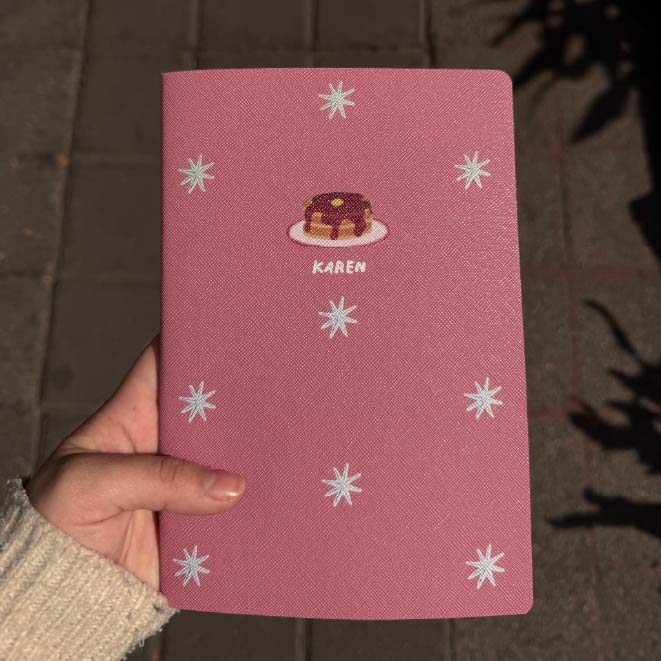
The Softcover Notebook is a good option for this: 13.4 × 20 cm, 100 pages of 90 g paper, lightweight and with rounded corners. It doesn't feel like an object you have to be overly careful with, but like an everyday companion. You can choose it ruled, if that helps loosen your hand, or blank, if you prefer to write and draw without guides.
If you like, it can also be personalized with your name or a phrase. Sometimes having a cover that says something of yours is the nudge you need to open it.
If you're just starting out, here's what journaling is and the difference between journaling and a diary.
Write what's there, not what should be there
A journal doesn't need extraordinary days. It needs ordinary days written honestly. Some will be three lines; others, four pages. Both count the same.
If today you don't know what to write, write the date and one word. Tomorrow, maybe, a page will come out.
Frequently asked questions
What should I write in a journal if my day was boring?
Write exactly that: what you did, what you ate, who you talked to. Ordinary days are the ones you'll enjoy rereading most over time, because they show what your life was like at that moment.
Do I have to write in my journal every day?
No. It's good to write often, but there's no rule. If days go by, you pick it up whenever you want and write about what's there today.
How do I start a journal from scratch?
Write the date, your mood in one word and three things that happened today. With that, you've already started. The rest builds up page by page.
Leave a comment
This site is protected by hCaptcha and the hCaptcha Privacy Policy and Terms of Service apply.