












It's 10:40 at night. You've already brushed your teeth, the notebook is on your nightstand and you think there's no time today to “journal properly.” So you don't. And not tomorrow either.
For most people, five to 15 minutes a day is enough for journaling to become a habit. There's no right amount: writing often matters more than writing a lot. Five minutes almost every day beats an hour once a month.
Why you don't need much time
The idea that journaling requires a quiet morning, a lit candle and a free hour is exactly what keeps many people from starting. Journaling isn't a long session, it's a short moment that repeats.
Think of it like washing your face: it's not what you do one day that shows, but doing it almost every day. A short page, written consistently, ends up telling more about you than three long sessions that stayed isolated.
Plus, a short amount of time takes the pressure off. If you know it's only five minutes, it's easier to sit down even when you're tired.
How much time depending on what you're looking for
Not all journaling is the same. This is a starting point, not a rule:
- To clear your head at the end of the day: five to 10 minutes. You write what happened and what kept going around in your mind, without organizing it.
- To give thanks or record the good things: two to five minutes. Three things, one line each.
- To answer a prompt or reflect on something specific: 10 to 15 minutes. You give space to a single question.
- To plan your week or review goals: 15 to 30 minutes, once a week. No need to do it daily.
- To process something difficult: as long as you need, but with a limit that takes care of you, like 20 minutes and a kind closing.
If you don't know what to write, journaling prompts help you spend those minutes writing instead of staring at the page.
How to find your moment of the day
The right moment is the one that already exists in your routine. Instead of inventing a new slot, attach journaling to something you already do:
- In the morning, with your first coffee, before checking your phone. It helps you get clear on what you want from the day.
- At lunchtime, at your desk or on a bench. A pause in the middle changes the afternoon.
- At night, at your nightstand, before bed. It helps you let go of what happened.
Try one time slot for a week. If it doesn't work, change it. It's not that you aren't consistent: sometimes it was simply the wrong time.
How to keep it up when you're short on time
There will be days when you can't. That doesn't break the habit, it just pauses it. Some ways not to drop it completely:
- Write a single line. “Today was long and I want to sleep” counts too.
- Use a timer. Set five minutes and stop when it rings, even mid-sentence.
- Keep the notebook in sight. If it's tucked away in a drawer, it's easy to forget. On your nightstand or in your bag, it practically opens itself.
- Don't try to make up for it. If you missed three days, you don't have to write three times as much. You pick it up today and that's it.
And if one day you sit down to write for five minutes and it turns into 40, that's fine too. The short time is a floor, not a ceiling.
A notebook that fits into your day
When time is tight, it helps for the notebook to be wherever you are. If you write in different places (the café, the office, the car while you wait), a small notebook makes it easier to use those loose minutes.
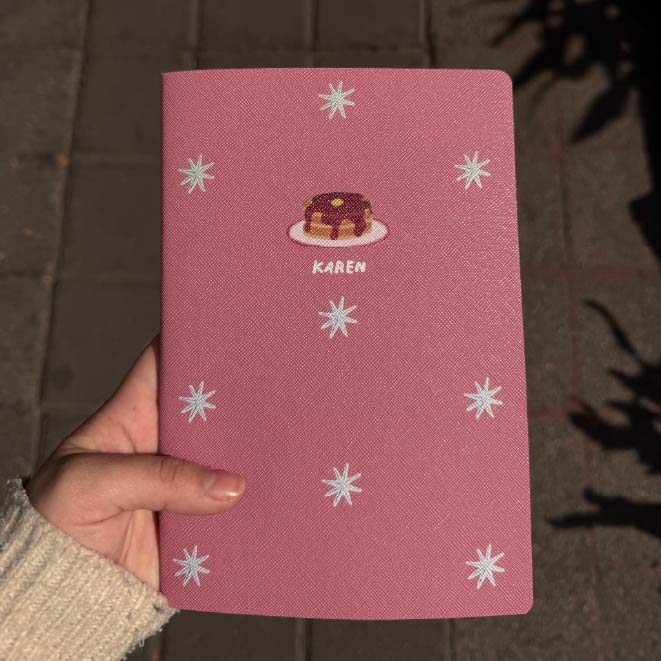
The Mini Pocket Journal measures 9.5 × 14.5 cm and has 192 pages, so it fits in almost any bag and holds months of short pages. You can personalize it with your name or a phrase, which makes it more yours and harder to leave behind.
If you prefer to always write in the same spot at home, a larger notebook works too. What matters is that opening it takes seconds, not a plan.
What does count as journaling
Sometimes we stop writing because we feel that what we do “isn't enough.” All of this counts:
- Three lines about how you feel.
- A to-do list with a note about how the week treated you.
- A phrase you read and want to keep.
- A quick drawing of something you saw.
Journaling isn't measured in pages or minutes. It's measured in the times you gave yourself a moment to listen to yourself.
Frequently asked questions
Is five minutes of journaling a day worth it?
Yes. Five minutes almost every day helps build the habit and get to know yourself better over time. Consistency matters more than the length of each session.
Is it better to journal in the morning or at night?
Neither is better in general. In the morning it helps you get clear on the day; at night, it helps you let it go. Choose the moment that already exists in your routine and that you can sustain.
What happens if I stop writing for several days?
Nothing. You pick it up today without making up for the days you missed. The habit is built by coming back, not by being perfect.
Leave a comment
This site is protected by hCaptcha and the hCaptcha Privacy Policy and Terms of Service apply.