







In your mom's drawer there's a diary with a little lock from when she was 14. On your nightstand there's a notebook where you write down what you feel, make lists of goals and answer questions you found online. Are they the same thing?
The difference between journaling and a personal diary is in the focus. A personal diary records what happened: what you did, who you saw, how the day went. Journaling includes that, but goes further: it's writing to understand yourself, with different techniques such as guiding questions, lists, gratitude or free writing. Every diary is a form of journaling, but not all journaling is a diary. In practice, the line between the two is thin, and most people mix both without realizing it.
How are they alike?
More than you'd think. Both:
- Are written for you, not for anyone else to read.
- Work best by hand and with some consistency.
- Keep a version of you that, over the years, becomes hard to remember any other way.
- Have no fixed rules. Nobody checks whether you're doing it right.
In both cases, what matters is honesty. A page that tells what really happened is worth more than a well-written page.
How do they differ?
| Personal diary | Journaling | |
|---|---|---|
| What you write | What happened during the day | What happened, what you feel, what you want, what you wonder |
| What for | To record and remember | To understand yourself, sort out ideas, let go, plan |
| How | Narrative, almost always in order | Narrative, lists, questions, gratitude, free writing, trackers |
| Perspective | Looking back | Looking back, inward and forward |
| Example | “Today I went to the movies with Ana and then we had tacos for dinner.” | “Today I went to the movies with Ana. Why is it so hard for me to say no to Thursday plans?” |
The clearest difference is in the last row. A diary tells. Journaling tells and then asks something.
Where does the word journaling come from?
A journal is a diary, and journaling is the act of keeping one. The word caught on, in English and in many other languages, to name a practice broader than the traditional diary: writing to get to know yourself, with different methods and tools.
That's why today people talk about types of journaling: gratitude journals, morning pages, bullet journals, journaling with prompts. They're all ways of writing for yourself, each with a different intention. If you want the full picture, here we tell you what journaling is.
Which one suits me best?
It depends on what you're looking for. A few clues:
- If you want to remember. A personal diary works for you. Writing every night what happened, with specific details —what you ate, what someone said, what song was playing— gives you a memory you'll be grateful for in 10 years.
- If you want to understand what you feel. Journaling with questions or free writing helps more, because it makes you dig beneath what happened.
- If you want to organize your life. Bullet journals, habit trackers or goal lists are journaling with a more practical focus.
- If you don't know. Start with a diary. Write what happened today. When you feel like asking yourself something, ask. That way, without noticing, you're already doing both.
Can you combine them?
Yes, and it's the most common approach. Many notebooks look like this: three lines about what happened, a question that came out of it, a to-do list in the corner and a sentence someone said that you don't want to forget.
There's no need to split them into separate notebooks, unless that helps you. Some people prefer one notebook for the diary and another for goals and plans. Some keep everything together. Both work; the one that matters is the one you're still using three months from now.
A notebook with your name
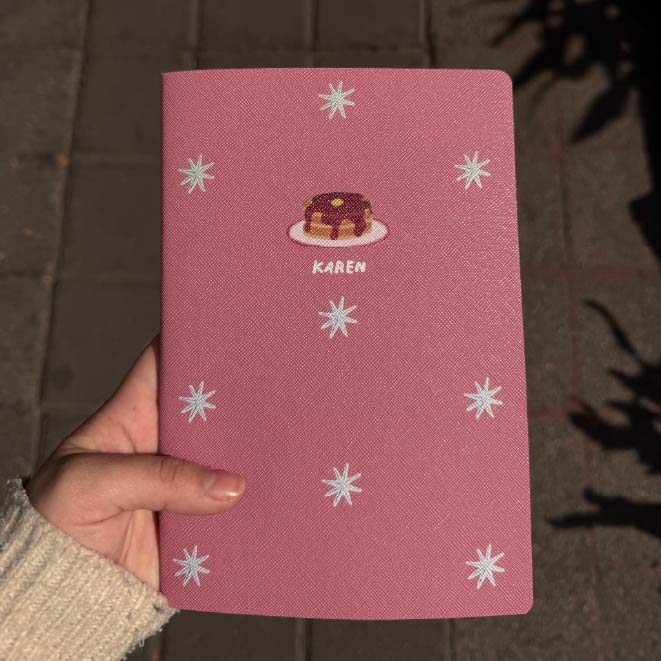
Whether it's a diary or a journal, it helps for the notebook to feel like yours from the cover. In the Customizable collection you can engrave your name, a date or a phrase, and see how it looks before you pay. It's a small detail, but it changes your relationship with the notebook: it stops being just any notebook and becomes the place where you keep your version of the days.
Frequently asked questions
Are journaling and a diary the same thing? Not exactly. A personal diary records what happened; journaling is broader and includes techniques for reflecting, sorting out ideas and planning. A diary is a type of journaling.
What's better to start with, a diary or a journal? To start, a diary is usually easier, because you just tell your day. Over time, if you feel like it, you can add questions, lists or gratitude.
Do I need a special notebook for journaling? It's not required, but it helps to have a notebook you only use for that. Wanting to open it is what makes the habit stick.

Leave a comment
This site is protected by hCaptcha and the hCaptcha Privacy Policy and Terms of Service apply.