







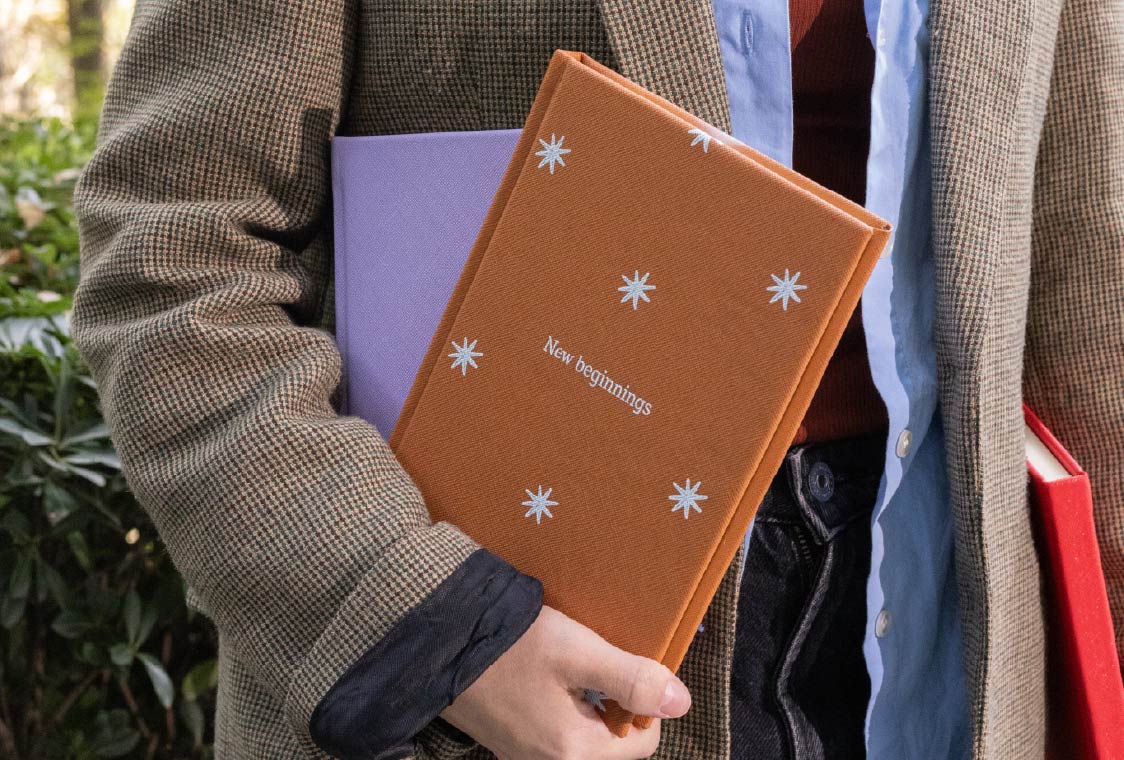

Mid-December. The house smells of Christmas punch, work has finally slowed down and you have a free afternoon with no plans. You take out this year's notebook, flip through it from January and are surprised by everything you no longer remembered.
End-of-year questions are a guide for reviewing in your journal what happened over the last 12 months before thinking about the next ones: what you lived, what you learned, what you want to let go of and what you want to take with you. Doing it in writing gives you something memory alone doesn't: the details, the order and the distance to see the whole year. Below are 27 questions to reflect on your 2026, grouped into four moments, and a way to do it in one afternoon before 2027 begins.
Before you start: how to close out the year
- Set aside two or three hours. You don't have to do it in one sitting, but do it calmly. A weekend afternoon works well.
- Gather your material. This year's journal, your planner, your phone's photo gallery. Flipping through them before writing brings back months that had faded.
- Write by hand. It's slower, and when closing out a year, slow helps.
- Don't answer everything. Choose the questions that move you. If one doesn't speak to you, skip it.
27 end-of-year questions for reflection, in four moments
To look at what happened
Start with the concrete. Before reflecting, you need to remember.
- What three moments from this year would you like never to forget?
- What happened this year that you didn't expect in January?
- Which places did you visit for the first time?
- What new people came into your life? Who drifted away?
- What was the hardest day of the year? How did you get through it?
- What book, song or movie kept you company at some point?
- Month by month, write one line about what you remember from each.
To see what you learned
Here the year starts to take shape.
- What do you know today that you didn't know a year ago?
- Which decision this year were you most afraid to make? How did it turn out?
- What did you change your mind about?
- What habit did you start, even if you left it half done?
- What are you proud of, even if nobody else knows?
- What mistake taught you something?
- If this year were a chapter in a book, what would it be called?
To let go
Before thinking about what's coming, it helps to make room.
- What weighed on you this year that you don't want to carry into the next?
- Which expectation wasn't met and is okay to let go of?
- What do you keep blaming yourself for? What would you tell a friend in your place?
- Who would you like to forgive, even if you don't tell them?
- What commitment do you keep out of habit and not because you want it?
- Finish the sentence: “This year I give myself permission to leave behind…”
For what you take into 2027
Now, looking ahead. No lists of impossible resolutions.
- What would you like to happen again next year?
- What do you want to do more of? What do you want to do less of?
- How do you want to feel in December next year?
- What small step can you take in January toward that?
- Who do you want to have closer?
- Choose one word for next year. Why that one?
- Write yourself a letter to open in 12 months.
What if my year was hard?
Some years you don't feel like reviewing. A loss, a change you didn't choose, months when you could only just hold yourself together.
In that case, you don't have to answer the questions about achievements or force yourself to find the bright side. You can stick to the ones about looking back and letting go, and write honestly about what it was. Sometimes closing a hard year is a single page that says: “This year was very hard, and I'm still here.” That's closing too.
Start the next one without waiting for January
Closing out a year doesn't have to wait for December 31, and the new beginning doesn't have to wait for January 1 either. If the questions left you wanting to organize what comes next, the Undated Planner has no printed dates: it has 160 pages for a year and you can start it on any day, so you can break it in as soon as you finish writing, with no wasted pages. To keep going in January, there's a 2027 prompt calendar with a question for each month, and a guide to planning your year in a planner.
If you want to make it concrete, here is how to write your goals on paper.
Frequently asked questions
When is a good time to close out the year in my journal? Any time in December works, or even the first days of January. What matters is having a quiet afternoon, without rushing, to flip through the year and write calmly.
How many questions do I have to answer? As many as you like. With five or six answered well, one or two from each group, you already have a complete year-end review. You don't need to answer them all.
What do I do with what I wrote? Keep it. Rereading your year-end review the following December, before writing the new one, is one of the loveliest parts of the exercise: you see how much everything changed in 12 months.
Leave a comment
This site is protected by hCaptcha and the hCaptcha Privacy Policy and Terms of Service apply.